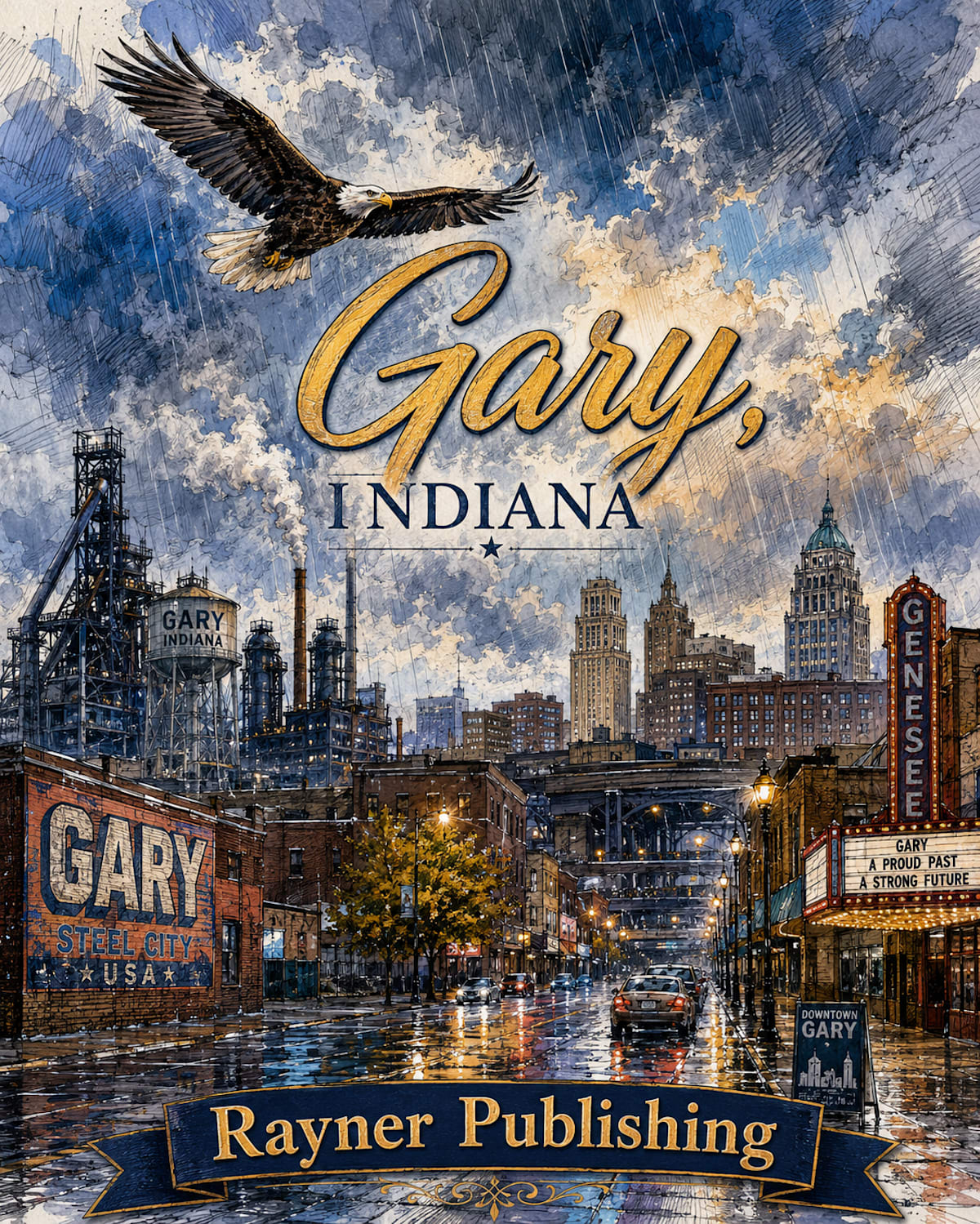
Type “Gary, Indiana” into a search bar and you’ll get abandoned buildings. Drone footage of the old Methodist church with trees growing through the roof. Somebody’s ten-minute video calling us the most miserable city in America.
Almost none of it is made by anyone from here.
I was born in Gary. My family is from Gary. I’m going to answer the question people actually type into Google — what happened to Gary, Indiana? — and then I’m going to tell you the part the drone footage always leaves out.
Gary was built by a steel company, on purpose
Gary didn’t grow the way most cities grow. It was manufactured.
In 1906, U.S. Steel bought up a stretch of sand dunes and swamp on the southern shore of Lake Michigan and built a city to serve its new mill. They named it after Elbert Gary, the corporation’s chairman. Gary Works went on to become the largest steel mill complex in North America.
Understand what that means: the city and the company were the same thing from day one. That’s not a metaphor. That’s the founding document.Then the whole country came
Word got out that there was work. Real work, the kind that paid.
Black families came up from the South in the Great Migration. Immigrants came from Eastern Europe and Mexico. My people came for the same reason everybody’s people came: a man could show up on a Monday and be earning by Wednesday.
They called it the Magic City. By 1930 the population hit 100,000. By 1960 it peaked around 178,000 — the second-largest city in Indiana. Gary steel built the highways, the skyscrapers, the tanks, the cars. The Jackson family came out of a small house on Jackson Street.
That’s who we were. Not a cautionary tale. The engine.
So what actually happened
There’s no single villain, which is exactly why the internet’s version is always wrong. It was a stack of things, and they all landed on the same people:
• Automation. The mills learned to make more steel with fewer men. Those jobs didn’t go on strike, get outsourced, and come back. They evaporated.
• Foreign competition. After the war, American steel dominated the world market. That didn’t last. Cheaper steel came in from overseas and the mills couldn’t answer it.
• No reinvestment. The plants aged. The technology aged. The money that could have modernized them went elsewhere.
• White flight and disinvestment. Families with means moved out to the suburbs. Businesses followed. The tax base followed. Banks stopped lending on our blocks.
• Everything downstream of that. When the work goes, the money goes. When the money goes, the schools strain, the buildings empty, the crime rises, and the same newspapers that ignored you for fifty years show up to photograph the ruins.
The numbers are brutal and simple: Gary Works employed something like 30,000 people around 1970. Three decades later, a fraction of that. The city’s population today sits somewhere in the high 60,000s — less than half of what it was in 1960.
That’s what happened. It wasn’t a mystery. It was a business decision, made repeatedly, by people who never lived on my street.
What the ruin porn never shows you
Here’s where I stop reporting and start testifying.
Every video about Gary shows the same four empty buildings. Nobody films the porches.
Nobody films the church that’s been full every Sunday for sixty years. Nobody films the cookouts, the block clubs, the grandmothers who raised half the neighborhood, the men who worked a double at the mill and still made it to the game. Nobody films the fact that tens of thousands of people still live here, still work here, still love it here — and are tired of being used as a backdrop for other people’s despair.
I’ve lived long enough to know the difference between a city that failed and a city that was left. Gary didn’t fail.
Gary was left.
And it is still standing.
Why I wrote a book about it
I got tired of us being described by people passing through.
The Flight of a Home Town Son: When the Smoke Hit Gary is my account — the smoke, the pride, the leaving, and what a place like that puts in a man that he carries for the rest of his life. It’s not a policy report and it’s not a highlight reel. It’s the truth as I lived it.
If you’re from Gary, you’ll recognize yourself in it.
If you’re not, this is your chance to hear it from someone who was actually there.
Read The Flight of a Home Town Son on Amazon →
More at raynerpublishing.com
— Kevin Rayner
Author. Publisher. Letter carrier. Gary made.